
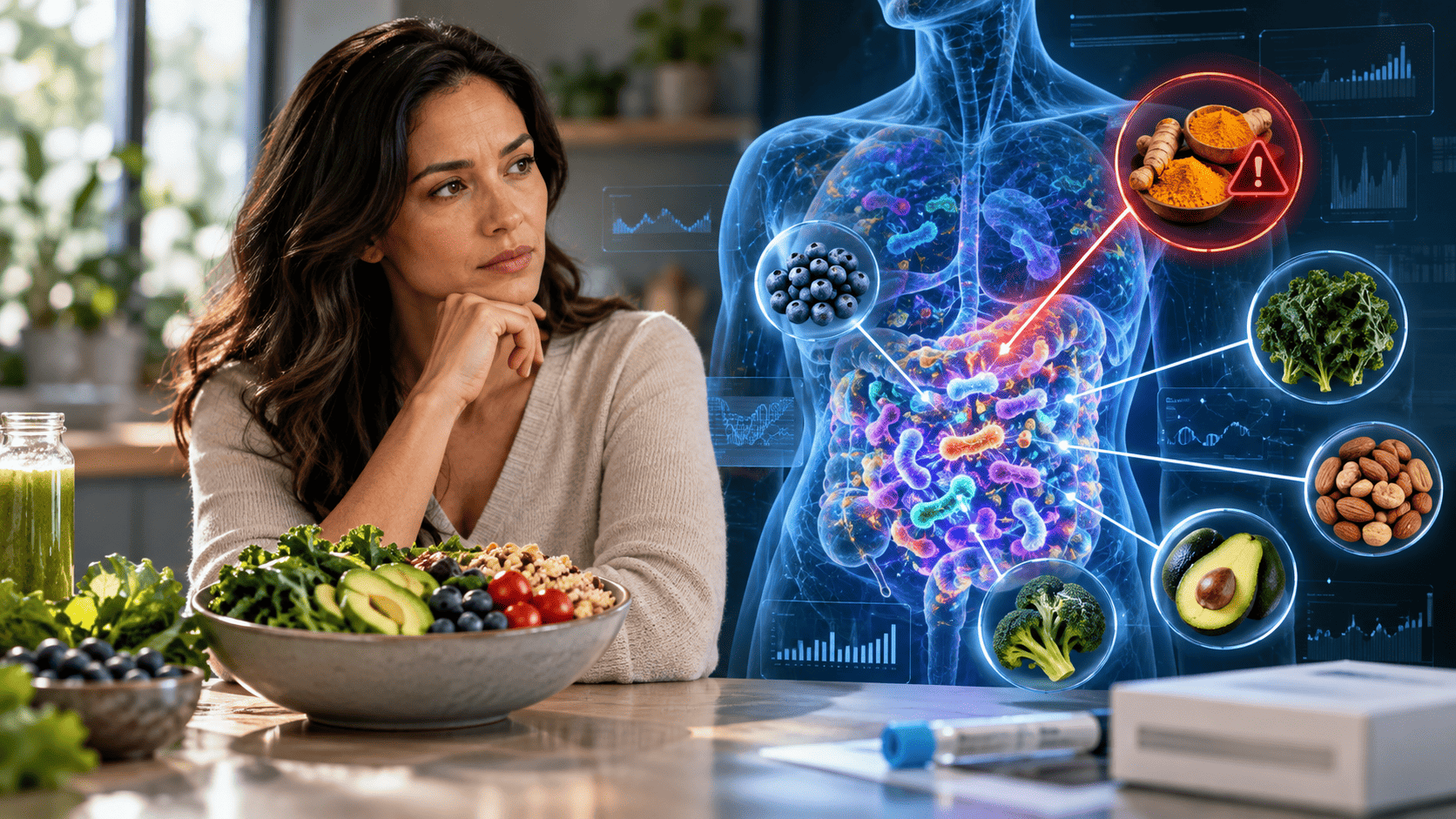
Why "Healthy Food" Might Not Be Healthy for Your Body
Most health advice is built for an average person who does not exist. Eat more vegetables. Manage stress. Sleep better. None of it is wrong, but it treats every body as though it runs on the same operating system, when in reality no two people process the same meal, the same supplement, or the same stress the same way.
Guruduth Banavar is the Founding CTO of Viome, a health technology company built to close that gap. Guru spent more than three decades in artificial intelligence, including leading Watson AI research at IBM, before shifting his focus to healthcare after watching his daughter and his wife each struggle with health issues that conventional, symptom-focused medicine could not fully explain.
In this episode of Lead with AI, Dr. Tamara Nall speaks with Guru about how Viome sequences RNA using a simple sample to build a picture of a person's biology, why that picture is designed to update roughly every six months, and why even a food with a healthy reputation showed up as a problem in his own results.
The Trouble With One-Size-Fits-All Health Advice
Guru did not set out to build a health company. For most of his career he worked on large-scale AI problems, eventually leading Watson AI research at IBM as a global vice president. The shift toward healthcare came from something personal. His daughter developed a set of unexplained symptoms that conventional medicine struggled to resolve, treating each symptom as it appeared rather than searching for a root cause. His wife faced a similar experience with an autoimmune disorder. Neither case responded well to an approach built around managing symptoms rather than understanding what was driving them.
That experience reframed how Guru thought about his own field. He wanted to apply AI to the roughly 70 to 80 percent of people, by his own estimate, living with some form of chronic disease, such as cardiovascular, metabolic, or neurological conditions. His goal became what he calls healthspan, not simply extending life, but keeping people able to live it fully for as long as possible.
How Viome Reads a Body at the Molecular Level
Viome's approach centers on RNA rather than DNA. DNA is fixed. RNA reflects what a person's cells and microbes are actually doing at a given point in time, which makes it a moving picture of health rather than a static blueprint. Customers send in a saliva, blood, or stool sample, sometimes all three for what Viome calls its Full Body Intelligence Test, and the lab runs a process called meta transcriptomics to extract genetic activity data. A single three-sample kit can generate somewhere around 90 million data points for one person. Multiply that across Viome's customer base, and Guru describes the resulting dataset in the quadrillions, a number with 16 zeros behind it.
Making sense of that volume takes more than raw computing power. Viome's AI draws on established research databases, including the Kyoto Encyclopedia of Genes and Genomes, to map genetic activity to specific biological functions such as inflammation, oxidative stress, and sugar response. Each function is scored against a large reference population, giving a person a sense of where they stand and what might be worth addressing first.
By Guru's account, the human body carries more microbial cells than human ones.
That is part of why he frames health as a joint project between a person's own cells and the trillions of microbes living alongside them, and why Viome treats microbial gene activity as seriously as human gene activity. Guru says customer data stays inside the company, with internal access limited to the domain experts who need it, HIPAA-aligned privacy practices, and ingredient safety reviewed against generally recognized safety standards.
A New Read Every Six Months
Unlike DNA, which stays fixed for life, Guru says a person's RNA profile tends to settle into a new stable state roughly every six months. That timeline shapes how Viome frames its recommendations. A single test is a snapshot, not a verdict. The real value comes from retesting, checking whether the last six months of food, sleep, stress, and movement moved a person's biology in a good direction, and adjusting from there.
This is also how the guidance evolves over time. A customer might improve one marker only to find a different one, like sugar response, has slipped. Viome's recommendations shift alongside those changes rather than repeating the same advice year after year.
When a "Healthy" Food Turns Out Not to Be
Guru's own results made the point better than any pitch could. Turmeric is widely considered an anti-inflammatory staple, and he had cooked with it constantly, confident he was doing something good for his body. Then a recent Viome test came back with a direct instruction: stop eating turmeric. The report traced the recommendation to his uric acid levels, which were being pushed in the wrong direction by the amount of turmeric he was consuming.
He describes the discovery as a reminder that biology tends to behave like a U-shape rather than a straight line. Too little of something is a problem. Too much can be a problem too, even when that something has a reputation for being universally good. There is no food that works the same way for every person at every dose.
The Health Crisis One Customer Turned Around
The story Guru returns to most is not his own. He describes a customer who came to Viome already dealing with a serious illness that conventional treatment had not resolved. After starting on Viome's personalized food and supplement recommendations, the customer began reporting significant improvement. According to Guru, the customer's biological age, as tracked through Viome's own methodology, dropped by roughly 12 years over about nine months.
Guru frames this as one individual's experience rather than a guarantee, and it reflects Viome's own internal tracking rather than an independently verified clinical result. Even so, he calls it one of the more striking outcomes he has seen. Stories like it have slowly brought some doctors around. Functional medicine, preventive medicine, and lifestyle medicine practitioners have been the fastest to incorporate Viome's data, Guru says, while more conventional doctors are coming along as the company publishes validation studies and runs randomized trials comparing its recommendations against a placebo arm.
What Guru Wants on Every Phone
Guru's long-term vision is straightforward: he wants Viome on every phone in the world. He compares the app to a health angel, something that lives in a person's pocket and can weigh in on a decision as small as what to order off a restaurant menu, checking it against what Viome already knows about that person's biology.
The bigger goal sits underneath that convenience. Guru's boldest prediction is that AI could eventually help address chronic disease for the majority of people currently living with one. He frames it as a hope rather than a promise, one that depends on continued research, better tools, and people willing to act on what their own biology is telling them.
Quick Answers
What is Viome? Viome is a health technology company that uses RNA sequencing and AI to analyze a person's gut microbiome and human biology from an at-home saliva, blood, or stool sample, then delivers personalized food, supplement, and lifestyle recommendations.
How is RNA different from DNA in what Viome measures? DNA stays fixed. RNA reflects what is happening in the body right now and shifts over time, which is why Viome uses it to track a person's biology as it changes rather than relying on a static genetic snapshot.
Can Viome help with an existing health condition, or is it built only for prevention? Viome is built primarily around prevention, but Guru also describes a customer managing a serious existing illness who followed the platform's personalized recommendations and reported major improvement. Results like this are specific to that individual and to Viome's own internal tracking, not a guarantee for every user.
How does Viome handle data privacy? According to Guru, Viome does not send customer data outside the company, limits internal access to the domain experts who need it for analysis, and follows HIPAA-aligned privacy practices.
Is there a discount code for Viome's Full Body Intelligence Test? Yes. Lead with AI listeners can save $100 on the Full Body Intelligence Test with code LEADWITHAI at viome.com.
Who is Guruduth Banavar? Guruduth Banavar is the Founding CTO of Viome. He spent more than three decades in artificial intelligence, including leading IBM's Watson AI research team, before turning his focus to healthcare after his daughter and his wife each faced health issues conventional medicine struggled to resolve.
For anyone curious what their own RNA might reveal, Viome is live at viome.com, with at-home tests covering gut, blood, and saliva samples. Lead with AI listeners can take $100 off the Full Body Intelligence Test with code LEADWITHAI.
For more conversations with the founders and leaders building the future of AI, subscribe to Lead with AI on Apple Podcasts, Spotify, YouTube, or wherever you listen.
Follow or Subscribe to Lead with AI Podcast on your favorite platforms
Website: LeadwithAIPodcast.com | Apple Podcasts: Lead-with-AI | Spotify: Lead with AI | YouTube: @LeadwithAIPodcast | Instagram: @LeadwithAIpodcast | Twitter (X): @LeadwithAI
Follow Dr. Tamara Nall
LinkedIn: @TamaraNall | Website: TamaraNall.com | Email: Tamara@LeadwithAIPodcast.com
Follow Guruduth Banavar (Founding CTO, Viome)
LinkedIn: @banavar | Instagram: @guruduthbanavar | Website: viome.com | LinkedIn (Viome): @viome
Comments