
How Illumix Is Teaching AI to Understand the Physical World
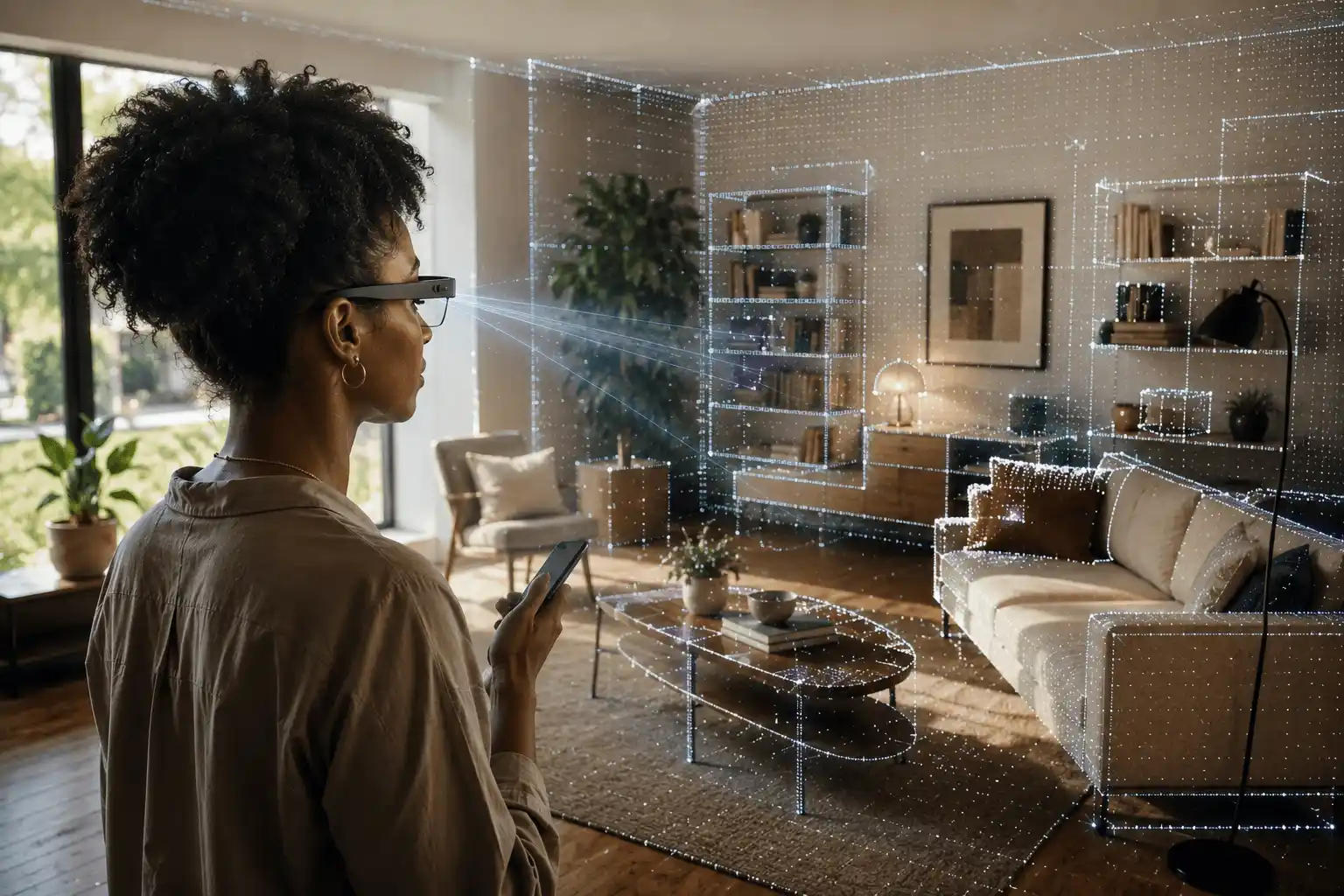
Human beings are extraordinary at reading physical space. A person steps into a room and, in an instant, knows where to walk, what has changed since the morning, and what the clutter on the table says about who was there. This happens without conscious effort, the product of millions of years of evolution. Computers have the opposite problem. They handle text and images with ease, yet understanding a three-dimensional space, recognizing that a room is the same room after the lights change or a coat lands on the sofa, remains one of the hardest problems in artificial intelligence. As more of computing moves off the desk and into the world, that gap is the thing standing between people and technology that fits into daily life instead of demanding attention.
Kirin Sinha is the Founder and CEO of Illumix, a spatial AI company building the infrastructure that lets software perceive and act in real-world environments. Admitted to MIT at sixteen, she earned degrees in mathematics, computer science, and electrical engineering, then completed graduate work at the University of Cambridge and the London School of Economics as a Marshall Scholar. She founded Illumix in 2017 and has spent close to a decade on a single question: what does it take for computing to operate at the level humans find effortless.
In this episode of Lead with AI, Dr. Tamara Nall speaks with Kirin Sinha about why machines still cannot read a room, how a horror game became the company's first proof that the technology felt real, why every camera frame stays on the user's device, and what changes when lightweight AR glasses finally deliver on their promise.
Why Machines Still Cannot Read a Room
Sinha frames the problem around a single observation: humans are evolutionarily wired for space, and computers are not. People remember locations, track objects, and move through a room without bumping into the furniture. A machine has to be taught each of those steps. The harder part is consistency. Computers read a scene pixel by pixel, so a living room at noon and the same living room under a lamp at night can register as two different places. A coat thrown over a chair or a tent pitched in the den scrambles the picture further. To a person, it is obviously the same space. To most systems, every changed pixel is a new puzzle. Illumix's work centers on closing that distance, getting software to the intuition a person applies without thinking. By Sinha's estimate, the field sits around 60 to 70 percent of human-level spatial understanding today, well above the roughly 15 percent baseline when she started, with the last stretch being the hardest.
Nine Years and Three Different Bets
Illumix is almost nine years old, and the product has changed shape more than once. The company started in gaming, building immersive stories that existed in a player's real surroundings rather than on a flat screen. Its first title was the augmented reality version of Five Nights at Freddy's, a horror game that placed animatronic characters inside a player's own home. That work led into large-scale entertainment, where the question became how a company without Disney's resources could still create the kind of character moments that turn a visit into a memory. Today much of the focus sits on AI and AR hardware, the lightweight glasses meant to lay a layer of useful information over the world instead of floating a screen in front of it.
The Night a Horror Game Made Players Back Into the Corner
The company's first real signal came during early playtests of that Five Nights at Freddy's game. Sinha and her team were not sure the effect would land. A player could always look up and see there was nothing in the room. What they watched instead was people retreating, pressing themselves into corners, heart rates climbing, reacting as if something were actually there with them.
That was the moment the technology stopped being a clever effect and started being an experience.
For Sinha, the proof was not the graphics. It was that the technology disappeared and the feeling took over, the same standard she still holds the company's work to.
Keeping Every Camera Frame on the Device
Because Illumix works through cameras pointed at people's personal spaces, privacy is not a footnote for Sinha. It is an architecture decision. The system processes everything in real time on the user's own device, so camera images never reach Illumix's servers. Sinha argues this is a stronger guarantee than a promise. A company can pledge not to touch user data, and that pledge is only as good as the company keeping it. An architecture that never sends the data anywhere removes the question altogether. The same choice pays off in speed, since a person looking around a room cannot wait several seconds for the software to catch up. Her test for any new product is blunt: build it so that misusing it is hard or close to impossible, rather than bolting on safeguards after the fact.
What the Glasses of 2030 Will Actually Do
Sinha sees two threads pulling the future into focus. Software and AI have hit an inflection point, improving at a rate that was hard to imagine two years ago. The open question is hardware. Most of Illumix's work still runs on phones, with growing projects on AI glasses. The glasses that look like ordinary eyewear are limited in what they can do, and the capable ones are still too heavy to pass for fashion. Sinha expects that gap to close by 2030, when a normal-looking pair of glasses will bring digital elements into the world and hand the wearer something close to a daily superpower. The thing keeping that future at bay is not vision. It is battery life, heat, and the physics of a good display.
The Trend She Thinks Everyone Overrates
Asked what the industry overvalues, Sinha points to foundational models as a competitive moat. The models are getting cheaper and faster so quickly that the gap between them keeps closing, which means the real value sits in deployment, data, and the application built on top. The trend she thinks deserves more attention is on-device inference, running capable AI on hardware a person owns, for the sake of privacy, speed, and independence from a connection. Her boldest prediction reframes the chatbot era entirely. She expects people will one day look back on today's AI chatbots the way they now look at the command line, an early and clumsy way of talking to a machine that gave way to something far more natural.
Quick Answers
What is Illumix? Illumix is a spatial AI company founded by Kirin Sinha in 2017. Its platform gives software the ability to understand three-dimensional space in real time across mobile devices, AR glasses, and robotics, and it runs on the device without a cloud connection.
What is spatial AI? Spatial AI is artificial intelligence that perceives and reasons about physical, three-dimensional space. It works out where it is, what objects are present, and what is happening, so a device can place the right information or action in the right spot at the right time.
How does Illumix protect privacy? Illumix processes camera data in real time on the user's own device, so images never reach the company's servers. Sinha treats this as an architecture choice rather than a policy promise, which also removes the lag that comes with sending data to the cloud.
Who is Kirin Sinha? Kirin Sinha is the Founder and CEO of Illumix. Admitted to MIT at sixteen, she holds degrees in mathematics, computer science, and electrical engineering, completed graduate work at Cambridge and the London School of Economics as a Marshall Scholar, and has been named to the Forbes 30 Under 30 list.
Can spatial AI be used in robotics? Yes. The same technology that helps a device understand a physical space applies directly to robotics, and Sinha names the broader physical AI movement as a growing area for the company.
What did Illumix build with Disney? Illumix went through the Disney Accelerator, and Disney invested in the company. Sinha describes bringing characters to life so they respond to people and their surroundings at centimeter-level accuracy, the kind of experience that turns a visit into a lasting memory.
For brands, builders, and technology leaders trying to make physical spaces respond to the people inside them, Illumix offers the spatial AI stack behind that shift. Learn more at illumix.com, or reach the team through the contact page to request a demo.
For more conversations with the founders shaping the next generation of AI, subscribe to Lead with AI on Apple Podcasts, Spotify, YouTube, or wherever you listen.
Follow or Subscribe to Lead with AI Podcast on your favorite platforms: Website: LeadwithAIPodcast.com | Apple Podcasts: Lead-with-AI | Spotify: Lead with AI | Podbean: Lead-with-AI-Podcast | YouTube: @LeadwithAIPodcast | Facebook: Lead with AI | Instagram: @LeadwithAIpodcast | TikTok: @LeadwithAIpodcast | Twitter (X): @LeadwithAI
Follow Dr. Tamara Nall: LinkedIn: @TamaraNall | Website: TamaraNall.com | Email: Tamara@LeadwithAIPodcast.com
Follow Kirin Sinha (Founder & CEO, Illumix): LinkedIn: @kirin-sinha | Website: illumix.com
Illumix: Website: illumix.com | LinkedIn: @illumix
Comments